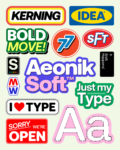
CoType has evolved its neo-grotesque workhorse with Aeonik Soft, featuring subtly curved corners that bring warmth, playfulness, and impressive versatility.
Aeonik Soft’s Starting Point
“Like many things at CoType, the idea came from client demand,” explains CoType’s founder Mark Bloom. For the London-based foundry, customisation requests had been arriving for a rounded version of Aeonik, and while the foundry was initially hesitant – wary of compromising its clarity and precision – it soon became clear that a softer interpretation would complement the family rather than detract from it. “Aeonik already speaks in several voices across the superfamily (like Mono and Fono),” Bloom adds, “and Soft started to feel like a natural next one.”
The challenge was to introduce a softer, more approachable expression while keeping Aeonik’s strong mechanical backbone intact.


Finding Balance
The team explored two approaches: a fully rounded version and a more restrained, “soft” one, pushing until the roundness threatened to overtake Aeonik’s DNA.
“The fully rounded version was interesting at first, but it quickly stopped feeling like Aeonik,” Bloom reflects, noting the tone shifted too far, especially in the Black weight. “In letters like ‘a’, ‘s’, ‘c’, and ‘e’, the rounded terminals no longer arched naturally and began to look almost worm‑like.” That made it difficult to maintain a consistent visual language across the weight range, so the team abandoned that direction early on. “For the softer approach,” he continues, “we created a variable font prototype where the amount of rounding gradually increased from very subtle to quite pronounced. We divided that spectrum into four visible steps and selected the one that felt clearly rounded, but not comical.”


A for ‘Anchor’
Throughout Soft’s development, the lowercase ‘a’ was an essential reference point because, as Bloom explains, it embodies so much of Aeonik’s essence. Once you start rounding the corners, especially in heavier weights, it can quickly drift into something more cartoonish.
“We needed to ensure that the top part of ‘a’ makes a full turn downwards and follows the backbone of the lighter weights,” he tells us. “If you were to round this part all the way, it would become a flatter curve, with no visible downwards ‘droop.’”
CoType also paid careful attention to elements like the tail of the ‘a’, which is much smaller than the usual stems and can therefore handle a lesser degree of rounding. In the end, the ‘a’ set the limit for how soft the typeface could become.
The same sensitivity applied to the ‘K’, which required “a surprising amount” of attention.
“In the heavier weights, rounding the corners of diagonal strokes subtly changes the width of the letter,” says Bloom. “Because the diagonals in ‘K’ and ‘k’ meet at different angles, the upper diagonal in particular became noticeably narrower, creating a small gap near the top of the letter. To compensate, we pushed the upper leg slightly outward, which subtly alters its angle compared to the original Aeonik. It’s a tiny adjustment, but it helps the letter feel balanced across the entire weight range.”


Specs and Details
Aeonik Soft consists of eight weights, ranging from Air to Black, with matching italics for each, plus a variable font option. While maintaining the original Aeonik structure, CoType made slight adjustments to proportions, spacing, and kerning to ensure a consistent softness and balanced texture across the range.
“Aeonik was originally built on a 1000 UPM grid, but once we introduced rounded corners, the curves didn’t always behave cleanly at that resolution,” says Bloom. “This was most noticeable in the Air weight, where stems are only 8 units thick. Some curves produced small glitches in the form of uneven connections, because the Bézier points and handles are forced to fit within the 1000 UPM grid. To resolve this, we increased the grid to 2000 units per em, which gave us a denser grid and allowed the rounding to render much more smoothly across the design space.”

Aeonik Soft provides a wide range of OpenType features, including discretionary ligatures, old-style and tabular numerals, fractions, case-sensitive punctuation, symbols, geometric shapes, circled numerals, and arrows. In line with Aeonik’s history of expanding language support, Bloom indicates that Soft is no exception:
“Another thing we’re quite happy about is that the entire Latin, Cyrillic and Greek character set could be successfully translated into the softer style.”
Audience and Use-cases
Aeonik Soft, like all members of the Aeonik family, is designed to excel across a range of sizes and media. Its rounded structure adds balance to branding, warmth to user interfaces, and a relaxed confidence to running text.
“It would be great to see Aeonik Soft used in projects aimed at younger audiences,” Bloom says. “The softened corners give the typeface a playful, approachable tone, making it a natural fit for children’s publishing, educational platforms, or friendly digital products. We could also imagine it working beautifully in museum or exhibition branding, where clarity and warmth are equally important.”
Bloom also highlights a recent example from Apple, which used semi‑rounded sans serif styles in marketing for products like the ‘affordable’ MacBook Neo, targeting a younger audience with a joyful identity and softened typography. For Bloom, it demonstrates how versatile this type of font can be: “With the right application, it can feel both approachable and contemporary across a wide range of contexts.”
Browse CoType’s font catalogue here.
Enjoyed this piece? Browse more of our typeface design editorials here.